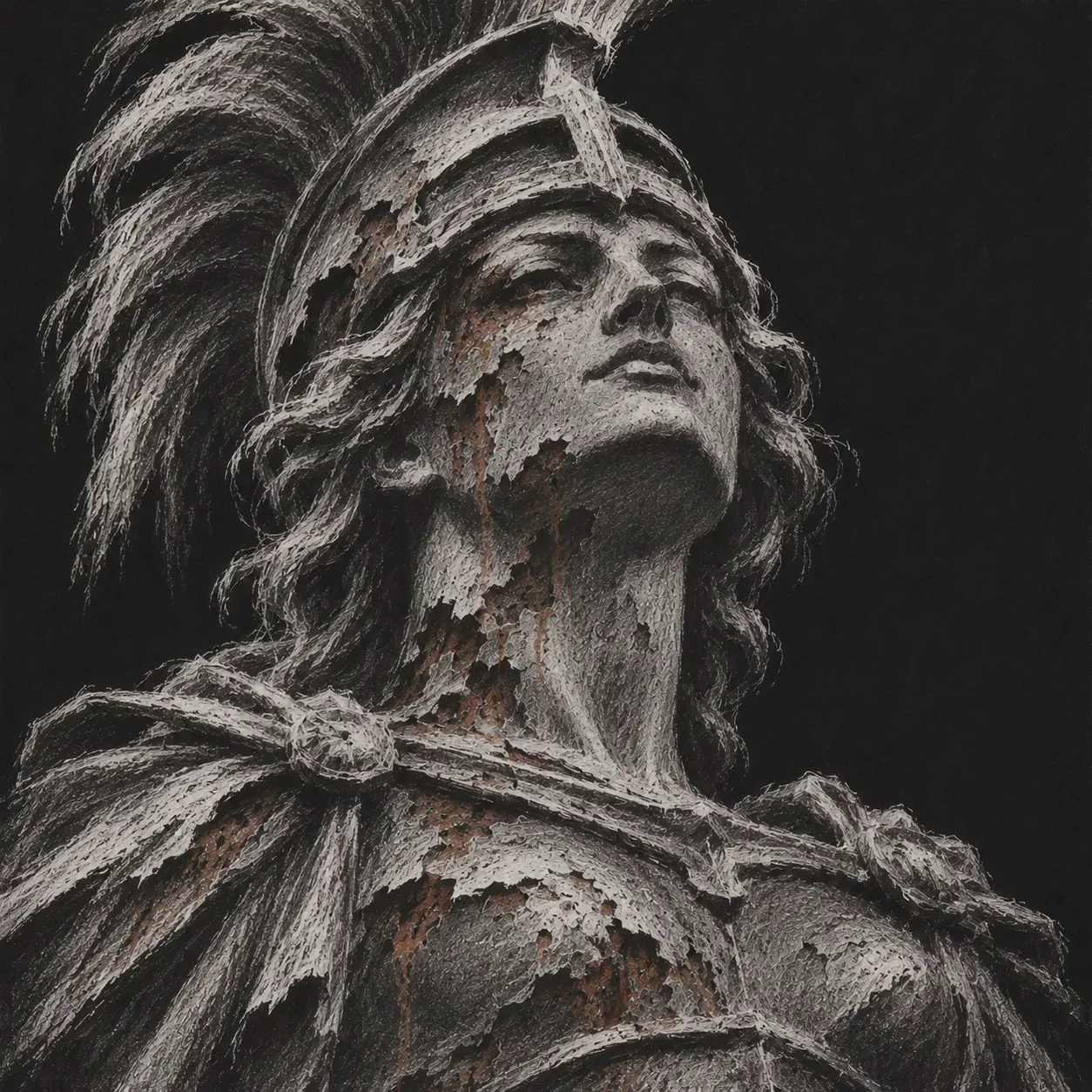
One Christmas I walked with my grandmother through Windsor Great Park, and we came out at the statue of Elizabeth II on horseback, looking out over the land from her plinth.
‘Ahh, you see,’ my Nana said. ‘That’s our wonderful history. That’s what Britain is all about.’
She was a devoted royalist and I loved her very much. I said it anyway.
‘No, Nana. That’s not our history. Our history is the Picts, Boudicca, Arthur. Magic.’
She rolled her eyes.
My Dad was a patriot. He served in the Territorial Army without ever having much time for the family at the top of it. As a boy he shook the Queen Mother’s hand at a school fair, and what he remembered of it, decades later, was her teeth. The worst he’d ever seen.
At school the Empire came to us as an achievement. Language, law, railways and parliaments carried round the world, and at the end of it Britain standing alone against Hitler.
Nobody asked what it had cost the people it was done to. I don’t think anyone knew there was a question.
I found the answer when I became a Sikh, and it wasn’t in any history I’d been taught.
The British spent the 1840s working their way into the Lahore court. When they annexed Punjab in 1849 the Maharaja was a boy of ten. They had already taken him from his mother, Maharani Jind Kaur, imprisoned her and driven her into exile. They raised him a Christian and shipped him to England. The Koh-i-Noor was taken from him in the surrender terms. It’s set now in the crown made for the Queen Mother — the one with the teeth.
In April 1919, at Jallianwala Bagh in Amritsar, General Dyer marched his troops into a walled garden full of protesters and pilgrims, blocked the way out, and fired into the crowd for ten minutes. The official count was 379 dead. Indian estimates ran past a thousand. Dyer was forced out of the army. Back home, readers of the Morning Post raised him a purse of some £26,000.
None of this is rumour. The Parliamentary Archives hold the inquiry the government commissioned itself.
Once I’d seen it in one place I started looking in others. British ships carried around 3.1 million Africans across the Atlantic. When Parliament finally abolished slavery in 1833, it paid £20 million in compensation — about forty per cent of the government’s yearly budget — to the owners, for their lost property. The enslaved got nothing, and most were kept working unpaid as ‘apprentices’ for years more. The loan raised to pay the owners was only cleared in 2015. Taxpayers paid it off, the descendants of the enslaved among them. The National Archives still hold the claims.
A party leader has said Britain shouldn’t apologise for any of this, because others took part and because Britain went on to end it. Others did take part. Britain did end it, and then paid the slavers. Neither is an answer. An apology isn’t every living citizen confessing to a crime. It’s an institution saying what it did. A state that inherits every coronation, every victory and every century of unbroken national life can inherit the debt as well.
The war is told the same way. Britain’s courage against Hitler was real. So was the courage of two and a half million volunteers from the Indian subcontinent, the largest volunteer army the world had seen, who get a sentence in the story if they’re lucky. In the same war, up to three million people starved in the Bengal famine under British rule. They don’t get a sentence at all.
Growing up, I heard one word about the poor more than any other. Scroungers. Newspapers, telly, both sides of the House. If you needed help, you had to prove you weren’t a cheat. The family at the top was given everything for being born, and the country called that heritage.
At eighteen I saw how that works from the wrong side of a fence.
I was home from university, out on a Friday night with two friends in the Great Park, drinking and smoking, trying to walk back to where I was staying. Somewhere past the Copper Horse we got properly lost. We followed a fence for what felt like miles, found a section propped up like a ramp, and went over.
We came down on perfect lawns, among fountains. Then the searchlights came on.
It was Andrew’s garden. He was still a prince then.
The men who came out of the dark were armed. We’d trespassed, we were a little drunk, and I had a tiny amount of cannabis on me, so I wasn’t expecting to be greeted warmly. I wasn’t expecting to be searched and kept standing in the cold without my coat either, or asked whether I belonged to any political organisations. I said I went on protests sometimes, and asked what that had to do with anything.
One of them leant in.
‘You should shut your mouth, it could be worse, you could be black or Irish.’
I’ve never forgotten it. It was the most honest thing anyone said all night.
The local police turned up eventually, annoyed to be dragged out for so little. I got a £120 fine instead of the usual warning — because, I was told, it was royal land.
A few weeks later the officer rang me in London. He needed my signature, or I could be taken into custody. I signed it in his car outside a pub in Lewisham at ten at night, then asked him how he slept, chasing a student across London over a bit of weed while real crimes went unsolved.
‘Well,’ he said, ‘I hadn’t really thought about it like that.’
‘Well, you should.’
My family tells it now as a funny story. From the outside, it is.
Sikhs close every service with the Ardas, a prayer said standing, and most of it is remembering. It names the Gurus. It names the four sons of the tenth Guru, the two youngest bricked up alive. It names those who were cut apart joint by joint, scalped, broken on the wheel and sawn in two, and still wouldn’t give up their faith. Every day, by name. It isn’t said to keep a grudge going. It’s said so you know whose people you are and what it cost them to stay.
Britain knows how to do this. Every village has a stone with names cut into it, and every November the country goes quiet for two minutes in front of them. I stood at those memorials as a boy with a poppy pinned on, and I meant it. A country that remembers its own dead that faithfully isn’t short of the habit.
What it has never had is the other half — the half I learned as a Catholic. In confession you don’t get to simply say mistakes were made. You must name what you did, what kind of thing it was, and how many times. Then you’re absolved, and given a penance, the first step in putting right what you’ve done. The point was never to hate yourself. People come out lighter, because the thing has finally been said out loud by the one who did it.
So the country has half of what it needs. It remembers what was done to it, by name and with great care. What it did to others it teaches as achievement, or doesn’t teach at all. Nobody needs it to hate itself, any more than the priest needs that from the penitent. The ask is smaller and harder. Say what was done, plainly, in your own voice. Then give back what can still be given back.
At eighteen I believed it could change. My friends and I went on marches, argued with anyone in uniform, and thought it all counted for something.
Fifteen years have gone since, on austerity, on Brexit and whatever came after, on the same parties trading places and the challengers promising to bulldoze the lot. I don’t blame anyone for wanting the bulldozer. Once you stop believing the machine can mend itself, demolition starts to look like a repair.
The questions we were shouting about are still where we left them. In 2025 the Joseph Rowntree Foundation reported that Britain had gone twenty years without a sustained fall in poverty. The election the year before gave one party nearly two-thirds of the seats on about a third of the vote, the most lopsided result on record. Last winter the Electoral Commission asked people whether politicians could be trusted. Nine in a hundred said yes.
That’s why the past matters to me. Nobody running the country now gave the order at Amritsar. But the habit that kept Amritsar out of my schoolbooks is still running things. The Empire was an achievement, the poor and the disabled are scroungers until they prove otherwise, and the system, by its own account, works. It’s the same zombie system I wrote about last time, with better ceremonies. A country that can’t say what it did can’t say what it’s doing either.
I live in Germany now. Walking through Berlin with my boyfriend not long ago, I saw a great stone arch from the imperial period and wanted a photo under it. He wouldn’t stand with me.
‘Such a British reaction,’ he said.
He was right. He grew up in a country that teaches you to look at a monument and ask what was done under it. I grew up in one that taught me to look at mine and admire the stonework.
I don’t hate Britain. What I feel is tiredness, fifteen years of it, and under the tiredness something closer to grief. England is part of me. I just can’t see how to make a life there any more.
Recently an email came from the Royal Borough of Windsor and Maidenhead, asking me to renew my overseas vote. I thought about it for a while, then closed it.
I know that isn’t an answer either. I’ve given up on the vote, not on the question. I can’t make the country say what it did, or what it’s doing. So I’ve said it here, plainly, in my own voice.