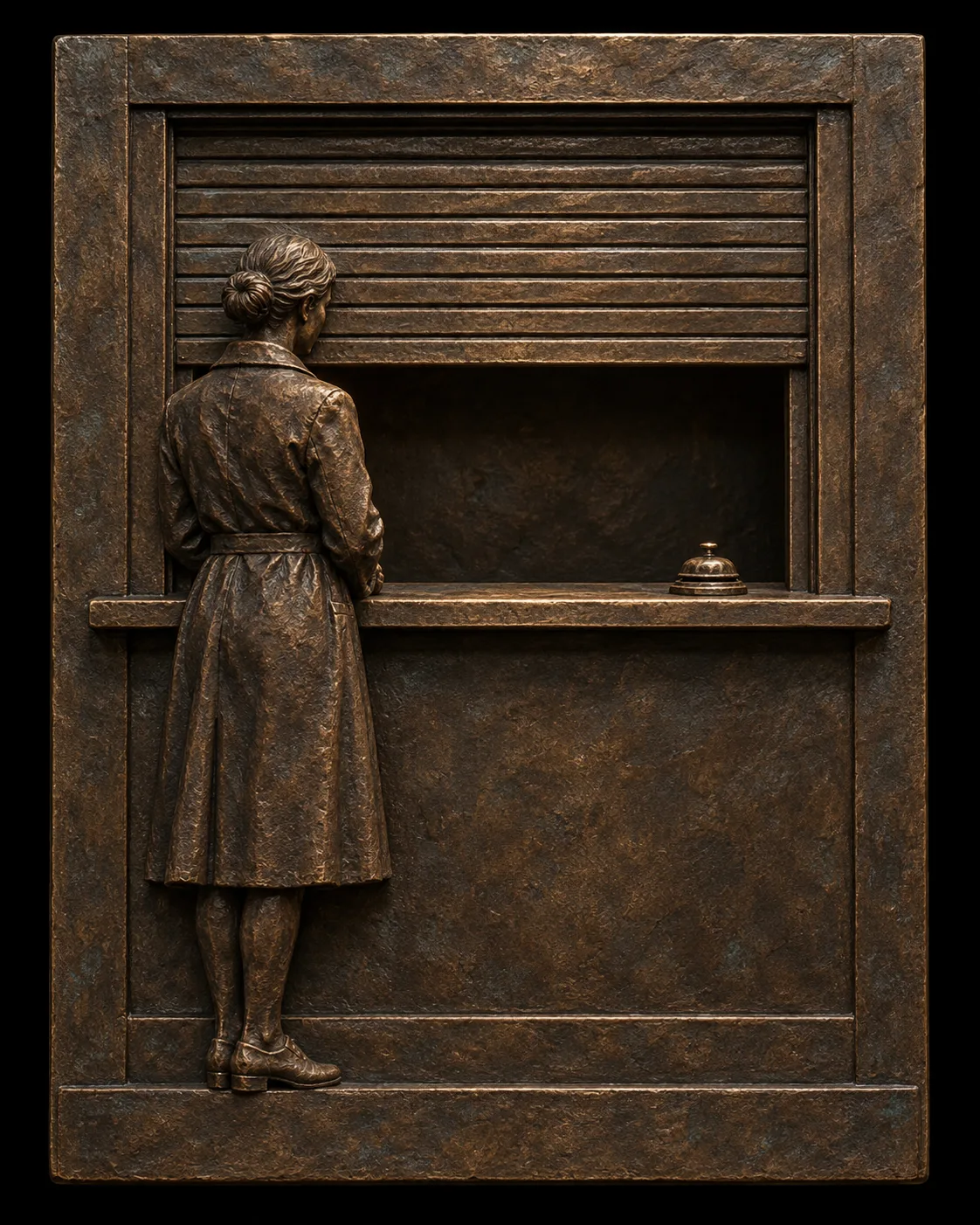
A few weeks ago I went to an animal shelter and asked for a calm dog. I was told none of them were calm. Nobody tried to find one that might suit me. When I picked one anyway, I was told to sit on the floor in front of its cage and feed it treats through the bars, and then the worker went off and didn’t come back. I sat there for five minutes with the dog barking in my face until I couldn’t take any more, and left. On the way out I found her and said the dog wasn’t settling. She shrugged. ‘They’re all stressed out here.’
What she said was true. It just wasn’t an answer.
There’s a standard I keep coming back to. Someone stands in front of another person with a problem. The one behind the counter sees that, and listens to what’s actually being asked. If they can help, they help. If they can’t, they explain properly why not, and they don’t treat the other person’s being there as an irritation.
Nobody has to smile for that. A tired, flat clerk can meet it, and a cheerful one can miss it while grinning the whole way through. What it asks for isn’t friendliness. It’s recognition: seeing that the one in front of you is a person, and that what they’ve brought has some claim on you.
Plenty of people still meet it, often in jobs that give them every reason not to. But its absence has got easier to notice. At a doctor’s reception, in a government office, on the phone to a company, anywhere one person needs another to use some judgement, the person with the problem can find they’ve become the problem. They come with a need and get handled as friction.
It would be easy to call that rudeness. That blurs it. There are two losses here, and they work differently.
The first is inside paid work. Someone can do every step their role asks and still not feel that whether the work does any good is their business. It comes down to which question they’re quietly answering: how little the role can get away with, or what’s been put into their hands and what it would take to see it through. At the shelter a dog had been shown to someone, so the step was done. Whether that dog and that person had any business together was left wherever it fell.
None of this should turn into a sermon at workers. Poor pay wears the care out of people. So does being short-staffed, being watched, being measured by numbers that have nothing to do with whether anyone was helped, being handed a script that rules out the sensible thing, and having no say in any of it. For all I know, the woman at the shelter was carrying all of that. An employer can make vocation nearly impossible. But the person at the counter didn’t write the script either, and they’re still standing there with their problem. When neither side holds up its end, work turns into compensated endurance, and doing the minimum becomes the sensible choice. The clock moves at the same speed either way.
The second loss lies outside any contract. It’s the things people do for nothing. The extra explanation. Three minutes of patience. Walking someone to the right place. No employer can organise that into existence. It gets given or it doesn’t, and ordinary life turns brutal when it doesn’t.
Two strangers pass in the street and one of them says hello. Sometimes warmth comes back. Sometimes what comes back is a look that asks why you’re talking to them at all. Most of us now have somewhere to retreat to: phones, headphones, cars, self-checkouts. Places get built around keeping contact to a minimum, and people get worse at the contact that’s left. I’ve started to wonder whether other people themselves have begun to feel like intrusions.
Some people meet both losses first: disabled people, elderly people, foreigners, anyone whose circumstances don’t fit the usual way of doing things. What they need is rarely special. Something explained. A reasonable adjustment. Someone patient enough to bend a little. But any step off the usual path now counts as extra work, so the person who needs that step becomes the thing that’s gone wrong.
I’m usually one of them. My German is broken, my eye contact is rarely the amount people expect, and my face is easy to read, sometimes wrongly. Any one of those is enough. I can watch the person behind the counter decide I’m going to be difficult before I’ve finished my first sentence, and from then on I’m handled rather than helped.
Sooner or later almost everyone becomes the awkward case.
Put the two losses together and you get something I can only call a zombie system. It still moves. It processes forms, takes money, sends letters and enforces rules, but nobody inside is answerable for what the running is for. Shelters, hospitals, companies and the state can all end up like this.
Under that sits a question I can’t get round. What happens when a culture loses any convincing account of why service, neighbourliness and care matter beyond self-interest? Work becomes the sale of pieces of your lifetime for money, and other people become demands on that time. Benedict XVI called the alternative the logic of gift: a society can’t be held together by contract and exchange alone.
The Good Samaritan reads differently once you’ve been on the wrong end of a script. The wounded man by the road isn’t an appointment. He isn’t anybody’s job, and others have already gone past. He’s an interruption on a journey that was meant to be about something else. The Samaritan stops, and the rest of his day goes differently because of it.
The person in front of you bears the image of God, and that doesn’t lapse when they don’t fit the form. To see someone properly is to let their problem take some of your time, whether or not anyone’s paying you for it.
I don’t always stop. Someone asks me for help with something and I answer quickly, but then I get nervous and pull back too soon. Often it’s only after I’ve walked away, when it’s already over, that I realise I was being invited to stay a little longer. I withdrew because withdrawing felt safer. No one handed me that script. It’s my own.
So the question left over is smaller than kindness and harder to get out of. When someone’s trouble turns up uninvited in the middle of your day, do you stop?