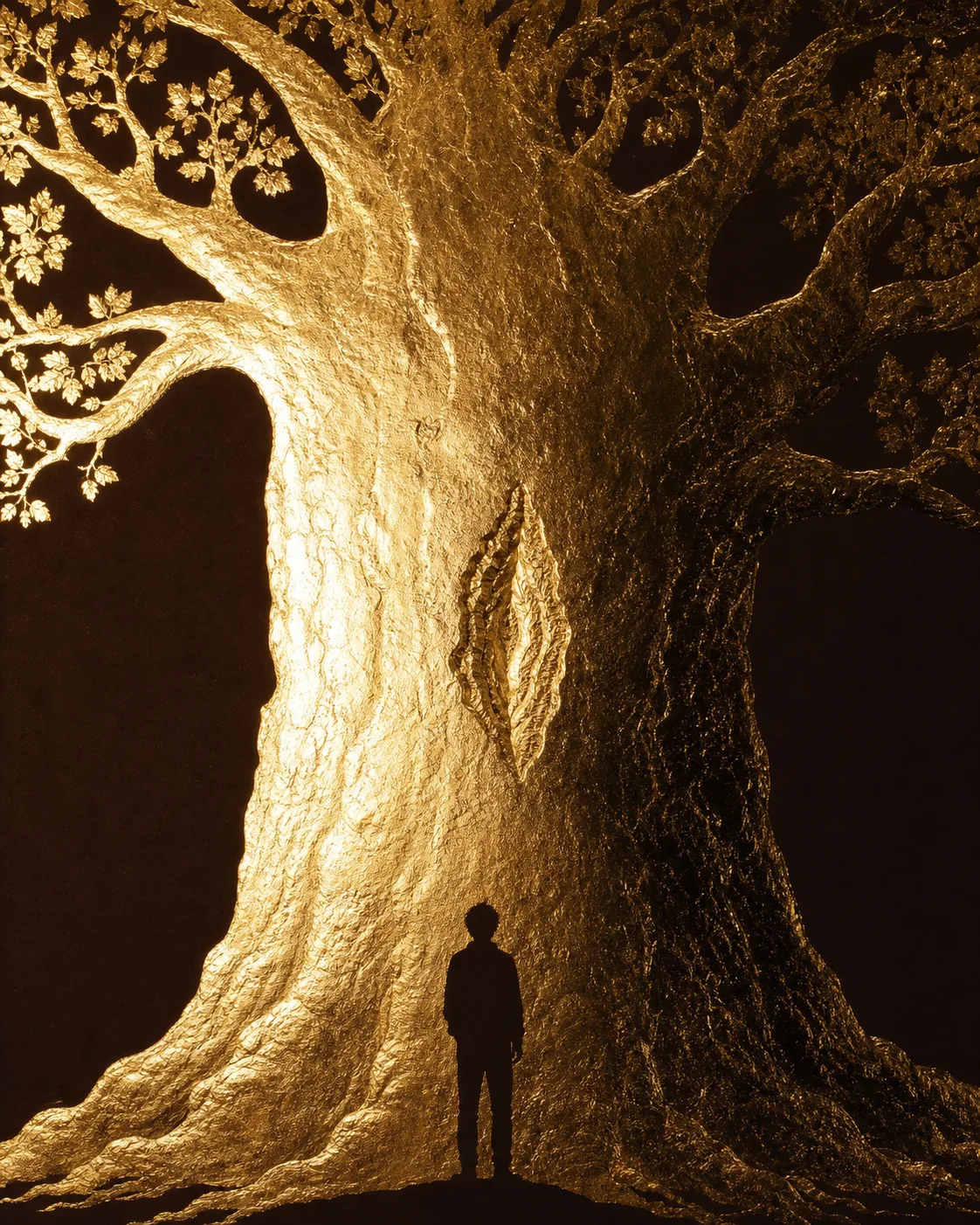
Step under a large tree in full summer leaf and the temperature drops, the sound changes, the light goes green. You are inside something alive.
Elder is not the same as old. Old accumulates deficit. Elder accumulates weight. A tree that has stood two centuries has not been worn down by those years — it has grown through them, and is still growing. What you are standing under is not a relic. It is a present thing that has been continuously becoming for longer than any person now living has been alive, and will keep becoming after the last of us is done.
The tree does not know you are there. The rings it is adding this year are not for you. You have stepped inside its life. It has not stepped inside yours. That asymmetry is the thing that stops you. It is also, now, what architects, urban planners, and ecologists have begun to build toward.
On the Ground
In the high desert outside Taos, New Mexico, Michael Reynolds developed what he called Earthships — houses built from discarded tyres packed with earth, their thick walls holding heat through cold nights and staying cool through summer days without mechanical assistance. The logic was thermal mass: material heavy enough to absorb the day’s heat and release it slowly through the night, or hold the night’s cool through the afternoon.
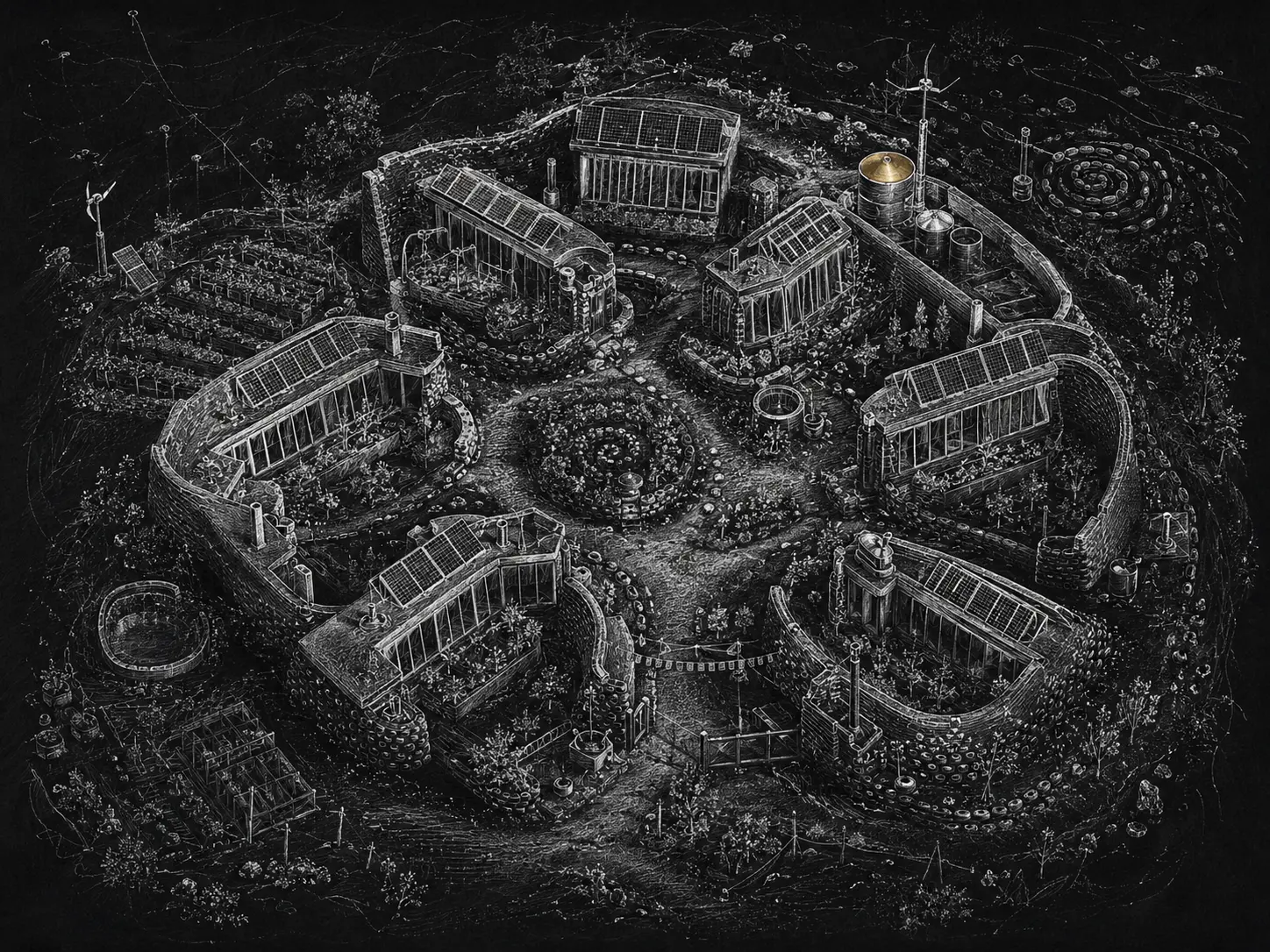
These buildings produce their own power from solar panels, catch their own water from rain and snow, treat their own greywater, and grow food in interior planters fed by that recycled water. The Greater World Community near Taos — the world’s largest off-grid legal subdivision — is what the concept looks like at neighbourhood scale. The building material is largely waste. The operating resource is largely sun. The dependency on centralised infrastructure is, by design, minimal.
This is what integration at the individual scale can look like. The building is not decorated with ecology. It operates through ecology — or near enough.
Take it off the ground and the logic goes vertical. Stefano Boeri’s Bosco Verticale in Milan — two residential towers completed in 2014, their facades carrying roughly eight hundred trees and tens of thousands of shrubs and plants — proved the skin of a building can hold a forest at height. Balconies become platforms for oak and hornbeam. The towers stand visibly alive against the skyline. The image was reproduced everywhere. The concept, copied.
Where the tower puts the forest on the building, the Miyawaki method leaves the building behind. Developed by the Japanese botanist Akira Miyawaki from the 1970s onward: dense planting of native species, layered by height, a multilayered forest in ten to twenty years. Applied across urban margins in Europe, India, and elsewhere — a strip beside a motorway, a corner of a car park that was no longer needed. The forest that results holds more water, cools faster, generates more biodiversity per unit area than conventional planting. The limitation is built into the scale. You can fit a Miyawaki forest into the margins. The city itself — its concrete, its car traffic, its energy demand — does not change.
Singapore took it to civic scale. The city-state has maintained urban greening as policy for decades — parks connected by green corridors, roadside canopy managed as infrastructure, the Jewel at Changi Airport built around a forty-metre indoor waterfall ringed with living planting. The reasoning is practical: equatorial heat in a dense city makes shade functional rather than ornamental. A tree canopy that lowers street temperature by several degrees is infrastructure in the same category as drainage.
Between what these projects prove possible and what they can deliver at scale, there is a gap. That gap is the honest problem.
Vertical forests are expensive to build and to maintain. The plant systems require structural engineering that conventional buildings don’t carry, specialist irrigation, horticultural staff with ongoing contracts. Bosco Verticale’s apartments sold at prices that placed them beyond most of the city they stood in. The ecological integration is genuine. The delivery vehicle is luxury housing. Singapore’s model functions because the city-state has a government capable of funding and enforcing long-term policy across a small, prosperous territory. What works in those conditions does not transfer automatically.
Rewilding operates at ecologically meaningful scale — Rewilding Europe’s projects across the Iberian peninsula, the Carpathians, Scandinavia, returning land to wolf and lynx and letting succession run — but rewilding requires land that was previously farmed or grazed. It is a social and economic question alongside the ecological one. The land does not depopulate itself. The communities it transforms carry costs that the ecological gain does not automatically offset.
On the Sea
Nor does the contradiction end with rewilding. Copenhagen’s Amager Beach Park is a two-kilometre artificial island built into Øresund — soft dunes, lagoon, swimming water within cycling distance of the city centre. It sits across the strait from the decommissioned Barsebäck nuclear plant on the Swedish shore. Engineered leisure adjacent to engineered risk, each the product of a different era’s confidence in what technology could manage.
Saudi Arabia’s NEOM project takes this logic to a different scale entirely: forty-one islands developed within the Red Sea’s ecosystem, Oxagon presented as the world’s largest floating industrial complex, THE LINE as a linear city run on renewable energy, Red Sea Global’s resort territory built on a commitment to develop less than one per cent of its total area. The ambition is real. So is the provenance. These are projects generated by capital derived from the extraction that created the problem they are partially designed to address. The ecological aspiration is not therefore false. But the contradiction is not incidental.
The scale problem is simple to state. The tree canopy a city needs to meaningfully cut the urban heat island, hold stormwater, support pollinators, and give people somewhere to stand inside something alive — that canopy takes decades to grow. The trees that would do the work are fifty years from doing it at full effect.
The Haudenosaunee — the Iroquois Confederacy — carry a principle that decisions should account for those not yet born, seven generations hence. That frame holds the time horizon honestly. You are planting them into a future that will exist without you, and that will need what you planted. The logic holds. The political horizon is shorter than the growing time required.
Closer to Home
In Berlin, trees are marked and organised in ways that make you stop. Round metal tags like dog collars. Red and white plastic caution tape wound around trunks in tight circles, strangling them with the administrative conviction that what needs managing is the thing in the way. Nobody seems to notice. The tape sits there, month after month, cutting into bark.
I pulled one of these tapes off a tree. It had bitten in; it came away stiff. Underneath was a lighter band on the bark where it had sat — a scar, the cellular record of pressure that should not have been there. The tree had done with the tape what a tree does with everything: grown around it, taken it into the account of its own body.
The world is not ready for the transition it needs to undergo. That is not a rhetorical position — it is a description of the present. The energy systems, the land-use patterns, the building stock, the economic arrangements that would need to change are too large and too interconnected for a transition to happen at the pace the ecological situation requires. We tag trees and call it management. We build artificial islands in seas we are warming. We design cities that will run on sun while the industry financing them runs on oil.
But necessity does not wait for readiness. A tree planted in an era that will not see it mature is still a tree planted. The civilisations that built cathedrals knew they would not see them finished. They built anyway — not because the outcome was guaranteed or the politics favourable, but because the commitment preceded those conditions. The commitment was the point.
What the elder tree offers, standing at the end of an ordinary summer street and doing nothing in particular, is this: proof that something alive can accumulate weight across time without the approval of any era it passed through. It grew through conditions it did not choose. The rings it added in difficult years are thinner, but they are there. It does not need the world to be ready. It needed someone to plant it, once, in ground that would hold.